


Ghost Scales: Why Moving Companies Calculate by Weight (And Why It Costs You More)
Free Estimate Online
Table of Contents
- 1. How Is Moving Shipment Weight Actually Measured?
- 2. How Weight-Based Moving Pricing Works
- 3. The Problem With Weight-Based Pricing: “Ghost Scales”
- 4. Our Industry Experiment: How Moving Companies Determine Shipment Weight
- 5. Why We Chose Volume-Based Pricing Instead
- 6. Weight vs Volume: A Practical Comparison
- 7. When Weight-Based Pricing Can Make Sense
- 8. A Simple Checklist for Customers Before Hiring a Moving Company
- 9. Why Volume-Based Moving Pricing Is More Transparent

How Is Moving Shipment Weight Actually Measured?
Moving long distances is expensive, and most customers expect the final cost to be based on something measurable and transparent. However, many people are surprised to learn that the price of a move is often calculated by shipment weight – a number that customers rarely see measured themselves.
Asking a simple question –
How exactly is my shipment weighed?
– often leads to surprisingly unclear answers.
Many moving companies calculate the cost of a shipment based on weight. But most customers never see how that weight is actually measured.
Our Small Industry Experiment
To better understand how this system works, we conducted a small industry experiment. We contacted 15 moving companies offering cross-border moving services between Canada and the United States and requested quotes for the exact same relocation.
The scenario was straightforward: a move from Toronto, Ontario to Nashville, Tennessee, with a fixed inventory list provided to every company:
- Coffee table (medium)
- L-shape sofa
- Stereo system
- 65” TV
- Queen bed and mattress
- Medium dresser
- PC computer
- PlayStation 5
- 2 stools
- 1 wardrobe box (large)
- 6 medium boxes
- 1 small box
Despite the identical inventory, the quotes we received varied dramatically – from $3,500 to $11,000.
Most companies based their estimates on a minimum shipment weight between 2,100 and 2,300 pounds, meaning that even if the actual weight of the shipment were lower, the customer would still pay for that minimum.
When we began asking follow-up questions about how this weight is actually calculated and verified, the answers became even more interesting. Out of the 15 companies contacted:
- Only 5 companies provided detailed explanations of how shipment weight is determined.
- None allowed the customer to be present during weighing.
- One company claimed to have its own scale, but said the shipment would be weighed without the customer present and a photo of the scale ticket would be sent afterward.
- Several companies avoided the question entirely or attempted to move the conversation to a phone call instead of answering in writing.
These responses raised an obvious question: If moving costs are based on shipment weight, how can a customer independently verify that weight?
To understand the answer, we first need to look at how weight-based pricing actually works in the moving industry.
2. How Weight-Based Moving Pricing Works
In many long-distance moves across Canada and the United States, the cost of transportation is calculated based on the estimated weight of the shipment. This system has been used in the industry for decades and is still the standard model for many interstate and cross-border moving companies.
At first glance, the process seems simple. A moving company typically follows three steps when calculating the price of a shipment:
Step 1: Estimated Shipment Weight
First, the company provides an estimated shipment weight based on the inventory list provided by the customer. Each item – furniture, boxes, appliances, and other belongings – is assigned an approximate weight using internal tables or industry averages.
Step 2: Minimum Shipment Weight
Second, most companies apply a minimum shipment weight. For long-distance moves, this minimum is commonly around 2,000 to 2,300 pounds. Even if the actual shipment weighs less, the price is usually calculated based on that minimum threshold.

Step 3: Additional Rate Per LBS
Third, if the shipment exceeds the estimated weight, the customer is charged an additional rate per pound above the estimate.
A simplified example might look like this:
- Estimated shipment weight: 1,900 lbs
- Minimum shipment weight: 2,200 lbs
- Rate for additional weight: $2.00 per lb
If the shipment ends up weighing 2,800 lbs, the customer would pay for the extra 600 lbs.
In theory, this system allows companies to calculate transportation costs based on how heavy the shipment is. However, the final price can depend heavily on how the estimate is structured. This is where the distinction between binding and non-binding estimates becomes important.
Binding vs Non-Binding Estimates
- A binding estimate means that the price is fixed based on the agreed-upon inventory list. As long as the shipment matches that list, the final cost should not change significantly.
- A non-binding estimate, on the other hand, is only an approximation. The final price may change after the shipment is loaded and the weight is determined.
In many cases, additional charges are calculated after the truck has already been loaded, when the shipment is supposedly weighed and the final weight is recorded.
For customers, this creates an important practical question: How exactly is that final shipment weight determined – and who verifies it? Before answering that question, it is important to understand a key issue within the system: the transparency of the weighing process itself.
3. The Problem With Weight-Based Pricing: “Ghost Scales”
How Shipment Weight Is Supposed to Be Measured
While weight-based pricing appears logical on the surface, the system raises an important issue for customers: transparency.
If the final price depends on shipment weight, the natural question becomes simple: How can the customer verify that weight?
In theory, determining shipment weight should be straightforward. A truck can be weighed before loading, weighed again after loading, and the difference would represent the weight of the shipment. Certified truck scales are widely used in freight transportation for exactly this purpose.
What Moving Companies Actually Told Us
However, residential moving often works differently. During our research, we asked 15 moving companies how shipment weight is actually determined and verified. The responses varied significantly.
- Five companies explained that they assign an estimated weight to each item based on internal reference tables or industry averages. In this system, furniture, boxes, and household items are each given a predefined weight, and the total shipment weight is calculated from those values.
- Two companies stated that the shipment would be weighed later, typically after pickup, and that the result would be provided afterward – for example in the form of a scale ticket or a photo of the weighing result.
- The remaining companies either avoided answering the question or stopped responding altogether when asked how the weight could be independently verified.
One detail was consistent across all responses: none of the companies said the customer could be present during the weighing process.
This means that in many real-world situations, the final shipment weight – the number that directly determines the final price – is calculated outside the customer’s visibility. As a result, the customer receives a final weight figure but may have little ability to independently verify how that number was determined.
In many cases, the shipment is never physically weighed in front of the customer.
For customers trying to understand their final moving cost, this creates an important transparency gap. To better understand how widespread this issue might be, we looked more closely at the responses we received from the moving companies we contacted.
4. Our Industry Experiment: How Moving Companies Determine Shipment Weight
To better understand how shipment weight is determined in real moving quotes, we conducted a small experiment.
Research Setup
We requested quotes from 15 moving companies offering cross-border moving services between Canada and the United States. Each company received the exact same moving scenario: a relocation from Toronto, Ontario to Nashville, Tennessee with an identical inventory list.
Despite receiving the same inventory and route, the quotes varied significantly – ranging from $3,500 to $11,000. Most companies based their estimates on a minimum shipment weight between 2,100 and 2,300 pounds.
Questions We Asked Moving Companies
After receiving the quotes, we asked each company a few simple follow-up questions:
- How is the final shipment weight determined?
- Where is the shipment weighed?
- Will the customer receive a certified scale ticket?
- Can the customer be present during the weighing process?

The answers revealed several different approaches:
Key Observation
Across all 15 companies contacted, none stated that the customer could be present during the weighing process.
In practice, this means that the final shipment weight – the number that determines the final cost of the move – is usually calculated after the shipment has already left the customer’s home and outside the customer’s direct observation. While this does not necessarily mean the system is inaccurate, it does mean that the customer often has limited ability to independently verify the measurement.

5. Why We Chose Volume-Based Pricing Instead
Because of the transparency issues associated with weight-based pricing, some moving companies have adopted a different approach: pricing based on shipment volume, measured in cubic feet.
Instead of estimating how much a shipment weighs, this system focuses on something much easier to observe – how much physical space the shipment occupies inside the truck.
Every moving truck has a fixed cargo capacity measured in cubic feet. By calculating the space required for furniture, boxes, and other belongings, movers can determine how much of the truck the shipment will occupy and price the move accordingly.
For many customers, this approach is easier to understand and verify.
Advantage 1: Volume Can Be Estimated in Advance
Unlike weight, the physical size of furniture and boxes can be estimated before the move. A sofa, a dresser, or a stack of moving boxes occupies a certain amount of space regardless of how much it weighs. By reviewing the inventory list and estimating the space required for each item, movers can calculate the approximate volume of the shipment ahead of time.
Advantage 2: Customers Can Measure It Themselves
One of the biggest advantages of volume-based pricing is that customers can verify the measurements themselves if they choose to. All it takes is a simple formula used in basic geometry: Length × Width × Height = Cubic Feet.
For example, measuring a piece of furniture such as a sofa typically takes less than a minute. If a sofa measures 7 feet (L) × 3 feet (W) × 3 feet (H), the volume would be 63 cubic feet.
Measuring an item at home with a tape measure is simple. Weighing the same item accurately at home is usually impossible.
Advantage 3: Fewer Price Surprises
Because pricing is based on space rather than weight, customers are less likely to encounter unexpected overweight charges after loading. If the inventory list matches the items being moved, the estimated volume typically remains consistent. As a result, the final price is often easier to predict before the move begins.
6. Weight vs Volume: A Practical Comparison
Both pricing systems – weight-based and volume-based – attempt to estimate the resources required to transport a shipment. However, they measure two very different characteristics of the same items.
Weight-based pricing focuses on how heavy the shipment is, while volume-based pricing focuses on how much space the shipment occupies inside the truck.
To better understand the difference, it helps to look at a few typical household items:
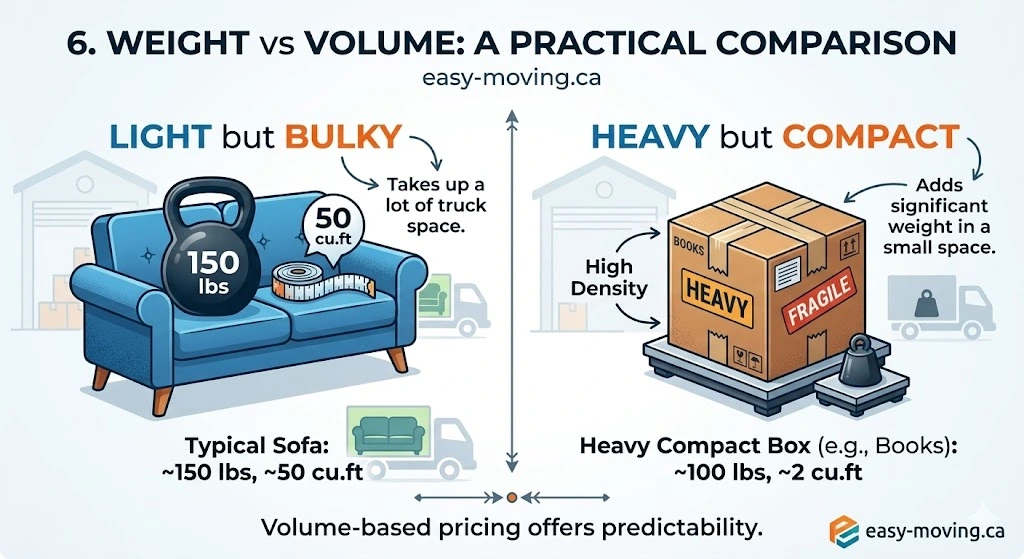
These examples highlight an important difference between the two pricing models.
Some items are light but bulky. For example, empty boxes, lamps, floor mirrors, or large plastic storage bins take up significant space in a moving truck but may weigh very little. In a weight-based pricing system, these items may have minimal impact on the final cost.
Other items are heavy but compact. Books, small appliances, and electronics can add substantial weight to a shipment while occupying relatively little space. In those cases, weight-based pricing may result in higher costs even though the items do not take up much room in the truck.
Because of this difference, neither system is universally "better" for every possible shipment. However, volume-based pricing often provides one key advantage: predictability.
7. When Weight-Based Pricing Can Make Sense
Although weight-based pricing can raise transparency concerns in some situations, it is important to recognize that this system is still widely used across the moving industry and can work well under certain conditions.
nterstate moves within the United States
- For moves that take place entirely within the US, interstate carriers are regulated by the FMCSA and the DOT. Certified truck scales are commonly used for commercial freight, and carriers are typically required to provide documentation of shipment weight if requested.
Large national carriers and van lines
- Major moving companies often operate large logistics systems that include access to certified weighing stations and established freight terminals.

Full truckload shipments
- Weight-based pricing can also make sense when a customer is booking a full truckload, meaning the entire truck is reserved for a single shipment.
While weight-based pricing can work well in these contexts, many smaller residential moves – particularly those involving shared truck space or consolidated shipments – may benefit from pricing systems that are simpler for customers to understand and verify.
8. A Simple Checklist for Customers Before Hiring a Moving Company
Before signing a moving contract, customers can protect themselves by asking a few simple questions about how the final price of the move is determined.
Question 1: Can you guarantee that the final price will not change after loading?
This question helps clarify whether the estimate is binding or non-binding. Understanding this difference can help customers know what to expect on moving day.
Question 2: If the price is based on weight, where is the certified scale located?
Many shipments are weighed at commercial truck scales or warehouse facilities. The company should be able to explain where that scale is located and how the weight will be documented (e.g., a scale ticket).
Question 3: Can I be present during the weighing process?
If the final price depends on shipment weight, customers may want to know whether they can observe the weighing process themselves. Even if being physically present is not practical, asking the question can provide insight into how transparent the company’s pricing process is.
9. Why Volume-Based Moving Pricing Is More Transparent
Our small industry experiment revealed something simple but important.
None of the 15 moving companies we contacted allowed the customer to be present during the weighing process.
This does not necessarily mean that weight-based pricing is inaccurate. However, it means that the number that determines the final cost of the move is often calculated outside the customer’s visibility.
Volume-based pricing offers a different approach.
Instead of relying on shipment weight, pricing is based on the physical space that items occupy inside the moving truck. Furniture and boxes can be measured, estimated in advance, and reviewed before the move begins.
For many customers, this makes the pricing process easier to understand and easier to verify.
If you are planning a long-distance move and want to avoid uncertainty around shipment weight, consider requesting a flat-rate quote based on shipment volume.
Don’t pay for "ghost weight."
Request a transparent, volume-based moving estimate for your next relocation. No hidden fees, no surprises.
Or call us directly: +1 (416) 520-3575
FAQ
This is a very common concern! First, professional movers pack trucks tightly for safety – leaving empty gaps causes items to shift and break during transit. Second, reputable companies guarantee the price based on your inventory list before the move, not based on how the truck looks loaded. If you haven't added new items to your list, your volume-based price remains the same, regardless of how it is stacked in the truck.
No, and that is the biggest advantage of pricing by cubic feet! A standard medium box takes up the exact same amount of space (about 3 cubic feet) whether it is filled with light pillows or heavy books. With a flat-rate volume quote, you are paying for the space on the truck, so heavy, compact items won't cause your bill to spike unexpectedly.
With volume-based pricing, adding items is completely transparent. The foreman will calculate the volume of the new items (Length × Width × Height) and apply the exact same rate per cubic foot that was agreed upon in your original estimate. You can even measure the new items yourself with a tape measure to verify the additional charge.
Movers use standardized industry software that assigns average cubic footage to standard items (e.g., a standard 3-seater sofa is usually 50-60 cu.ft.). However, if you have oversized, custom, or antique furniture, we highly recommend sending dimensions or photos. This allows us to provide an exact, guaranteed quote.
Not necessarily. Many large, established van lines across the US and Canada strictly use weight because it is a long-standing Department of Transportation standard for freight. If you must use a weight-based mover, always ask for a Binding Estimate (a guaranteed flat rate) so the price won't change after the truck crosses the scale.
Contact us
Address:
1181 Finch Ave W #13, North York, ON M3J 2V8
Telephone:
E-mail:
Hours of work:
Mon - Fri: 8.00 a.m. - 8.00 p.m.
Sat: 9.00 a.m. - 7.00 p.m.
Sun: 10.00 a.m. - 6.00 p.m.