


Prefer a quick overview? Watch this short video explaining the customs documents required when moving from the United States to Canada:
Customs Documents for Moving from the USA to Canada: BSF186, BSF186A & CBSA Clearance Guide
Moving from the United States to Canada involves more than loading a truck and crossing the border. Your household goods must go through Canadian customs – and without the right documents, your shipment can be held, delayed, or turned back at the border.
The Canadian government requires specific forms before your belongings can enter the country duty-free as personal effects. These forms need to be completed correctly, submitted in the right order, and stamped by a Canadian Border Services Agency (CBSA) officer before your moving truck arrives at the port of entry.
This guide walks you through every document you'll need, how to fill them out properly, and how the customs clearance process actually works – step by step, in plain language. Whether you're working with Cross Border Movers Toronto or coordinating the process yourself, this is what you need to know before moving day. The same CBSA requirements apply whether you are arranging a move from New York to Toronto, relocating from Florida to Toronto, or planning a long-distance move from Texas to Toronto.
Looking for pickup, delivery, and moving cost examples? Explore our USA to Canada moving services. This guide focuses on customs documents and preparation.
How the Canada Customs Process Works for Household Goods
Most people moving to Canada are surprised to learn that customs clearance for household goods is a process that begins before your shipment reaches the border. The way you prepare your paperwork – and where you present it to a CBSA officer – determines how smoothly your move goes.
The Role of the Canada Border Services Agency (CBSA)
The Canada Border Services Agency is the federal agency responsible for controlling the flow of people and goods across Canada's borders. For anyone moving to Canada, the CBSA enforces the rules that determine which personal effects can enter the country duty-free, what needs to be declared, and what documentation is required to support the import of household goods.
When you move from the USA to Canada, your household goods do not automatically enter the country tax-free just because they belong to you. You need to formally declare them to CBSA using the correct forms and prove that the items were owned and used by you prior to your move. The officer reviewing your documents will verify that your shipment matches what was declared and decide whether any duties or taxes apply.
For the vast majority of people relocating from the United States, qualifying as a settler – someone establishing permanent or long-term residence in Canada – means your used personal belongings can enter duty and tax-free. The key word is used. New or unused items purchased before the move, or items not listed on your customs forms, are treated differently.
Goods Accompanying vs. Goods to Follow
CBSA draws a clear distinction between two categories of personal effects when you move to Canada:
- Goods Accompanying refers to items you are bringing with you at the same time you enter Canada – luggage you carry on your person, items in your car, or a small load you personally transport across the border on the day you arrive.
- Goods to Follow refers to everything else – the household goods and personal effects that will arrive in Canada after you have already entered the country. This is the category that applies to the contents of your moving truck or shipping container.
This distinction matters because each category is processed differently and requires different documentation. Your CBSA officer will note which category applies to each item when you present your customs forms. Once something is declared under one category, it cannot be switched to the other after the fact – so accuracy matters from the start.
Why Most International Moving Shipments Are Declared as Goods to Follow
In practice, almost all household goods moved from the USA to Canada by professional movers are classified as Goods to Follow. Here's why.
When you relocate, the logistics of packing, loading, and transporting a full household takes time. Your moving truck typically departs the USA at a different time than you do. You may fly to Canada, drive separately, or cross the border days before or after your shipment. In all of these scenarios, your goods are following you – not traveling with you.
Even when a mover and the client cross the border at the same time, the paperwork process requires that customs forms be presented at the port of entry before the truck proceeds. The forms themselves – the BSF186 and BSF186A, which we'll cover in detail next – are specifically designed to accommodate the Goods to Follow process. They allow CBSA to issue a receipt for your declared goods so that when your shipment physically arrives at the border, it can be cleared against that receipt.
Understanding this distinction is the foundation of the entire customs documentation process for your move. In the next section, we cover exactly which forms you need and how each one works.
Required Customs Documents for Moving to Canada
When your household goods cross from the United States into Canada, CBSA requires a specific set of documents to process the shipment. There is no single customs form that covers everything – you need a combination of official CBSA forms and supporting personal documents, all prepared before your goods reach the border.
Getting this wrong is one of the most common reasons moving shipments get delayed at the port of entry. Missing a form, using an outdated version, or submitting incomplete information can hold your truck at the border while you scramble to fix it.
Here is exactly what you need.
Main CBSA Forms Required for Household Goods Import
There are two primary CBSA forms that every person moving household goods to Canada must complete:
- Form BSF186 – Personal Effects Accounting Document
- Form BSF186A – Goods to Follow Inventory (also called the List of Effects to Follow)
Both forms must be completed by the person relocating to Canada – not by the moving company. The mover can help you prepare them, but the legal responsibility for accuracy rests with you as the importer of record. Both forms must be presented to a CBSA officer in person and stamped before your shipment arrives at the border.
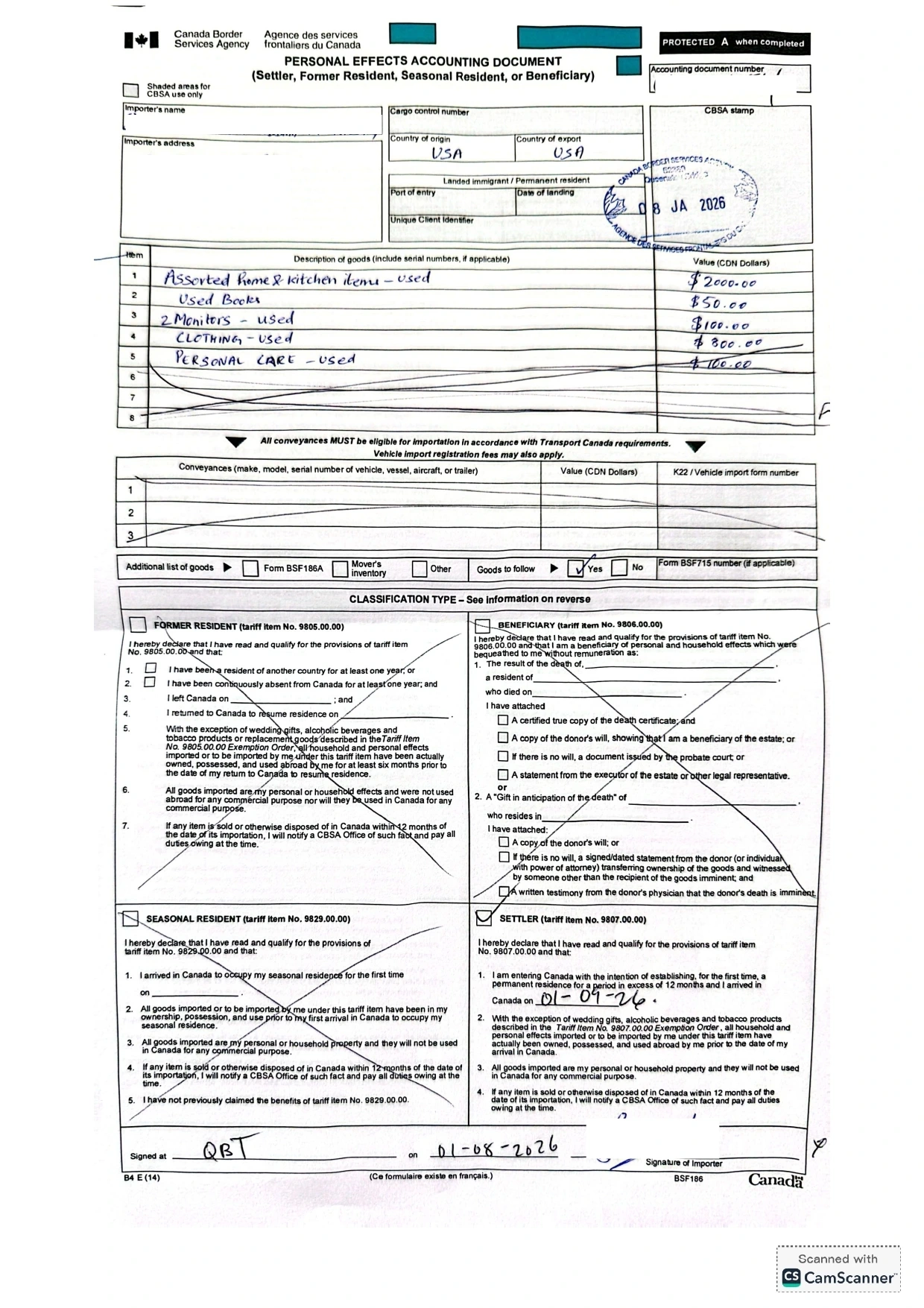
Form BSF186 – Personal Effects Accounting Document
The BSF186 is the core customs declaration form for anyone importing personal and household effects into Canada. Think of it as your official statement to CBSA that you are establishing residence in Canada and are entitled to import your used personal belongings duty and tax-free.
This form covers your personal details, your immigration status, and a general declaration of the goods you are bringing with you and the goods that will follow. It is the document that establishes your eligibility as a settler or returning resident and authorizes the duty-free importation of your household goods.
The BSF186 is available for download directly from the CBSA website. Always download the most current version before completing it – CBSA periodically updates its forms, and border officers will reject outdated versions.
What Information Must Be Included
- Personal details: Your full legal name, date of birth, Canadian address you are moving to, and country of last permanent residence (in this case, the United States).
- Immigration status: The type of visa, permit, or status that entitles you to live in Canada – for example, a work permit, study permit, permanent resident visa, or Canadian citizenship. The form has a dedicated section for this, and your declared status must match the immigration documents you present alongside the form.
- Goods Accompanying: A general description and estimated value of any personal items you are bringing with you on the day you enter Canada – items in your luggage, in your vehicle, or otherwise in your immediate possession at the time of entry.
- Goods to Follow: A general reference to the household goods that will arrive after you enter Canada. The detailed inventory of these goods is recorded separately on Form BSF186A.
- Declaration and signature: You must sign the form confirming that the information provided is accurate. Providing false or misleading information on a customs declaration is a serious legal matter under the Customs Act.
Note: The BSF186 must be completed before you enter Canada for the first time with the intent to establish residency. If you have already entered Canada prior to your goods crossing the border, you should still have this form ready, but the circumstances of your entry may affect how CBSA processes it. A professional international mover familiar with Canada-USA relocations can advise you on the right approach for your specific situation.
Form BSF186A – Goods to Follow Inventory
The BSF186A is the detailed inventory list that accompanies the BSF186. While the BSF186 declares that your goods are coming, the BSF186A documents exactly what those goods are.
This is the form that lists every item in your moving shipment – room by room, box by box, or item by item. It is the document that CBSA uses to match your declared goods against your actual shipment when the truck arrives at the port of entry. It is also the form that prevents disputes about whether a particular item was declared or not.
How Detailed the Inventory List Should Be
The BSF186A should be thorough and specific, but it does not need to be exhaustive to the level of individual socks or kitchen utensils. CBSA expects a reasonable, good-faith description of the contents of your shipment.
The standard practice is to list large items individually by name and description – furniture, appliances, electronics, bicycles, musical instruments, and similar items. For packed boxes, you list the contents of each box in general terms: "box of kitchen items," "box of bedroom linens," "box of books," and so on.
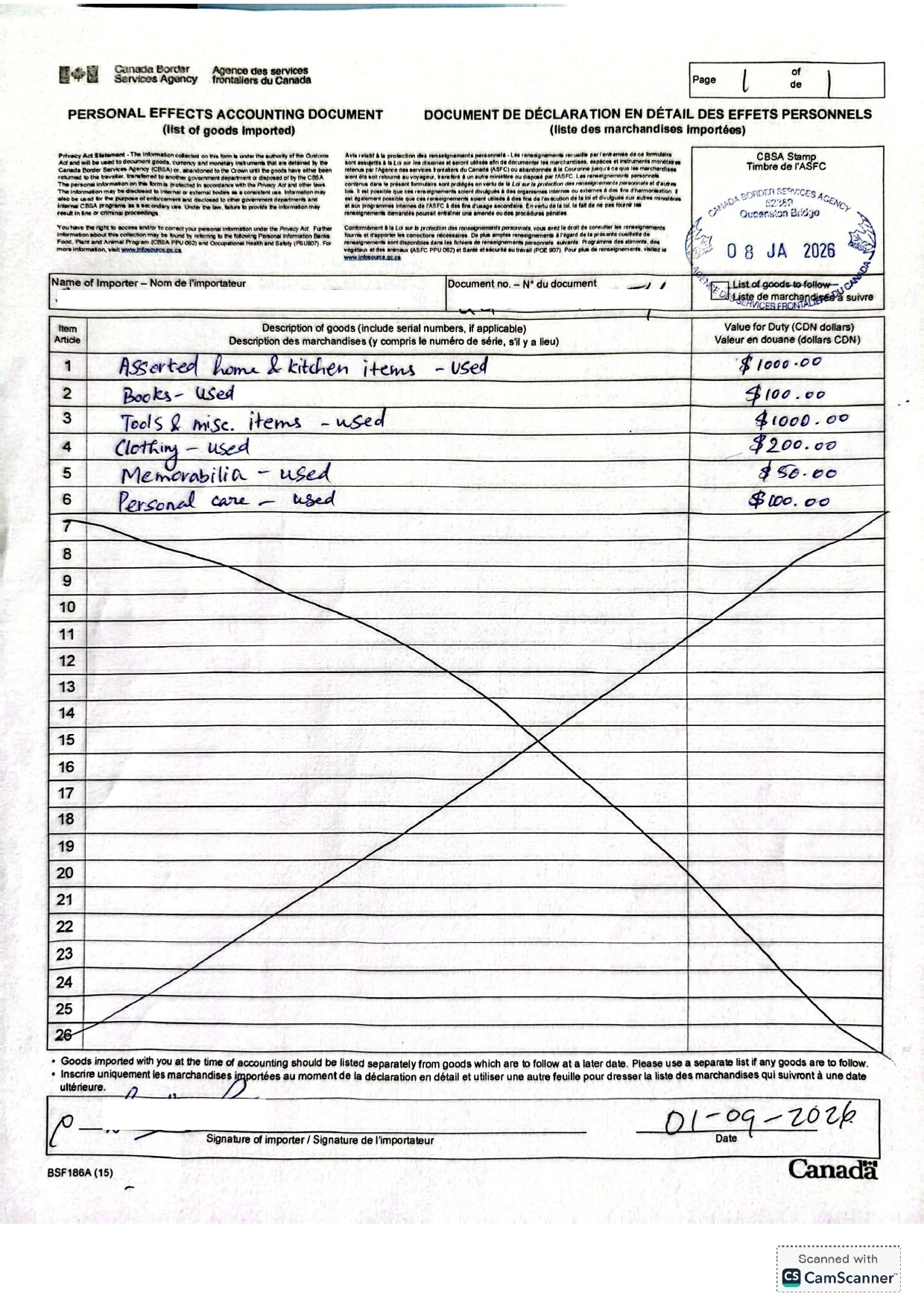
Each entry on the BSF186A should include:
- A clear description of the item or box contents
- An estimated value in Canadian dollars
- The quantity of each item
The total estimated value of all goods listed on the BSF186A will be cross-referenced against your BSF186. The values do not need to be precise market appraisals – reasonable estimates based on the current used value of your belongings are acceptable. However, intentionally undervaluing high-value items like jewelry, artwork, or electronics is not advisable and can create problems during inspection.
One common question is whether to list items by room or by box number. Either approach is acceptable, but listing by room tends to make the document easier for a CBSA officer to review quickly. If your moving company provides a packing list with box numbers and contents, that list can be used as the basis for your BSF186A inventory – but the final document must be submitted on the official CBSA form, not on your mover's packing list alone.
Supporting Documents Required by CBSA
In addition to the BSF186 and BSF186A, you must present supporting personal documents when you appear before a CBSA officer to have your customs forms stamped. These documents verify your identity and confirm your legal right to enter and reside in Canada.
Passport, Visa, or Immigration Documents
Passport: You must present a valid passport. For most people moving from the USA, this is a US passport. CBSA uses your passport to confirm your identity and record your entry into Canada.
Immigration documents: The type of document you need depends on your immigration status. Common examples include:
- Permanent Resident (PR) visa or Confirmation of Permanent Residence (COPR): Required if you are immigrating as a permanent resident.
- Work permit or study permit: Required if you are moving to Canada on a temporary basis under one of these authorizations.
- Canadian citizenship documentation: If you are a Canadian citizen returning after living abroad, you will need to show proof of citizenship.
CBSA officers will verify that your immigration status matches what you declared on the BSF186. If there is any inconsistency between your forms and your immigration documents, the officer may hold the processing of your customs declaration until it is resolved.
It is strongly recommended to bring original documents, not photocopies. If your immigration paperwork is still in process or has not yet been issued, speak with your moving company or an immigration consultant before your moving date. Attempting to present customs forms without the corresponding immigration documentation will delay clearance.
In some cases, CBSA may also ask for additional supporting documents such as proof of your former US address (a utility bill or lease agreement) or proof of purchase or ownership for high-value items. These are not always required, but having them on hand is a reasonable precaution for a smooth border experience.
How to Properly Prepare BSF186 and BSF186A
Knowing which forms you need is only half the work. Filling them out correctly is where most people run into trouble. The BSF186 and BSF186A are straightforward documents, but small errors – a missing signature, vague item descriptions, or mismatched values – can cause your shipment to be held at the border while corrections are made.
This section walks you through the preparation process from start to finish.
Step-by-Step Process for Filling Out Customs Forms
Follow this sequence when preparing your customs documents for a move from the USA to Canada:
- Download the current versions of both forms. Go directly to the CBSA website and download the latest versions of Form BSF186 and Form BSF186A. Do not use forms from third-party websites, old emails, or documents saved from a previous year. CBSA updates its forms periodically, and an outdated form will be rejected at the border.
- Complete the BSF186 first. Fill out all personal information fields accurately. Your name must match your passport exactly. Your Canadian destination address must be the address where you are actually establishing residence – not a hotel or temporary accommodation. Indicate your immigration status correctly and ensure it matches the visa or permit you will be presenting to the CBSA officer.
- Prepare your inventory before completing the BSF186A. Before you write anything on the BSF186A, compile a full list of everything in your shipment. Go through your packing list or walk through each room of the home you are leaving. Identifying every item before you start filling out the form prevents omissions and ensures the final document is complete.
- Complete the BSF186A using your inventory. Transfer your inventory onto the official BSF186A form. Group items logically – by room, by category, or by box number – and assign a reasonable Canadian dollar value to each entry. If the form runs long, CBSA accepts additional continuation pages as long as they are clearly labeled and attached to the main form.
- Review both forms before signing. Check that the total estimated value on your BSF186A aligns with what you have indicated on your BSF186. Confirm that your name, address, and immigration status are identical on both forms. Sign and date both documents – unsigned forms will not be processed.
- Make copies. Print at least three complete sets of your forms and supporting documents: one set for the CBSA officer, one set for your moving company, and one set for your own records. Keep your personal copies accessible during the entire move – you may need to reference them when your shipment arrives at the border.
How to List Household Items and Packed Boxes Correctly
The way you describe your belongings on the BSF186A matters more than most people expect. Vague or generic descriptions give CBSA officers less to work with and increase the likelihood of a closer inspection or a request for clarification.
For individual items, be specific about what the item is, its approximate age, and its condition where relevant. Instead of writing "television," write "65-inch flat screen TV, used, approx. 3 years old." Instead of "chair," write "leather office chair, used." This level of detail confirms that the items are genuinely used personal effects, which is the basis for their duty-free status.
For packed boxes, describe the contents by category rather than listing every individual object inside. Good examples:
- Box 1 – Kitchen items: pots, pans, utensils, small appliances
- Box 2 – Bedroom: clothing, shoes, personal accessories
- Box 3 – Living room: books, picture frames, decorative items
- Box 4 – Office: files, stationery, desk accessories
Avoid generic descriptions like "miscellaneous" or "personal items" without further context. A CBSA officer reviewing a list full of miscellaneous boxes has no way to verify the contents without opening them – which is exactly what you want to avoid.
For high-value items – jewelry, fine art, musical instruments, antiques, collectibles, or electronics worth more than a few hundred dollars – list each piece individually with as much identifying detail as possible. If you have receipts, appraisals, or photographs of these items, keep them with your supporting documents.
Declare currency and monetary instruments to CBSA when their combined value is CAD $10,000 or more, including the Canadian-dollar equivalent of foreign currencies.
Common Mistakes That Cause Customs Delays
After years of handling cross-border moves between the USA and Canada, the same errors come up repeatedly. Here are the ones most likely to slow down your shipment:
- Presenting forms that have not been stamped by CBSA. Your BSF186 and BSF186A must be physically stamped by a CBSA officer before your moving truck arrives at the port of entry. If your moving company shows up at the border with unstamped forms, the shipment cannot be cleared. The truck will wait – sometimes for hours – while you arrange to have the forms processed. This is the single most avoidable delay in any cross-border move.
- Submitting the forms after your goods have already crossed. CBSA requires that your customs forms be presented and stamped either when you personally enter Canada or at an airport port of entry before the shipment arrives. If your household goods reach the Canadian border before you have completed this step, you will face significant delays and potentially additional scrutiny.
- Listing items you no longer own or omitting items you do own. Your inventory must reflect the actual contents of your shipment. Including items that are not in the truck or leaving out items that are creates a discrepancy during inspection. Discrepancies raise questions that take time to resolve – and in some cases, result in duties being assessed on items that should have been exempt.
- Using estimated values that are obviously inconsistent. You do not need precise appraised values, but your estimates should be reasonable. Declaring a full household of furniture, electronics, clothing, and appliances at an implausibly low total value will attract scrutiny. Use realistic used-market values as your benchmark.
- Incomplete or missing immigration documents. If your visa, work permit, or PR documentation is not in order at the time you present your customs forms, the CBSA officer cannot verify your eligibility for duty-free importation. Your forms will not be stamped until the immigration side of your entry is resolved.
- Not accounting for restricted or prohibited items. If your shipment includes items that require special declaration – certain firearms, plants, food products, or items subject to import restrictions – and these are not noted on your forms, you create a problem at inspection. We cover restricted items in detail in a later section of this guide.
Taking the time to prepare your forms carefully before moving day eliminates most of the customs problems that delay shipments at the Canadian border. A professional international moving company with experience in USA-to-Canada relocations will review your completed forms before your move date and flag any issues before they become border problems.
Two Ways to Complete Customs Clearance When Moving to Canada
One of the most practical questions people have when moving from the USA to Canada is: where and when do you actually present your customs forms to CBSA? The answer depends on how you are entering Canada and how your shipment is being transported.
There are two accepted methods for completing customs clearance on your household goods. Both are legitimate, and both result in the same outcome – a CBSA-stamped BSF186 and BSF186A that allows your moving truck to cross the border. The right option for you depends on your travel plans and the logistics of your specific move.
Option 1 – Meeting the Moving Truck at the Canadian Border (Niagara Falls / Lewiston Bridge)
The most direct way to complete customs clearance is to meet your moving truck at a land port of entry on the day the shipment crosses into Canada. Commercial moving trucks must use a crossing that accepts commercial traffic. Rainbow Bridge is for travellers only; Queenston–Lewiston Bridge serves both travellers and commercial traffic. Confirm the crossing with your moving company before travel.
Here is how the process works at a land border crossing:
- You arrive at the port of entry separately from the moving truck – typically in your personal vehicle. You present your completed BSF186, BSF186A, passport, and immigration documents to a CBSA officer at the primary inspection lane or the commercial vehicle facility, depending on how the crossing is organized at that location.
- The CBSA officer reviews your documents, confirms your immigration status, and stamps both forms. This stamped set of documents is then handed to the truck driver, who presents them when the moving truck crosses through the commercial vehicle inspection area.
- The truck is then cleared to enter Canada based on your stamped paperwork. In most straightforward cases, the shipment proceeds without being physically unloaded or inspected, though CBSA always reserves the right to conduct an inspection if they choose to.
Practical considerations for this option:
- Coordinate the timing carefully with your moving company. You need to arrive at the border crossing before or at the same time as the truck – not after. If the truck arrives without stamped forms and has to wait, you are paying for idle time and potentially disrupting the driver's schedule.
- Confirm in advance which crossing your moving company will use. Not all border crossings handle commercial moving truck traffic, and your mover will have a preferred route based on the origin and destination of your move.
- If you are driving to Canada and the moving truck is following the same route, your moving company can coordinate a meeting point near the crossing to ensure you process your forms before the truck reaches the commercial lane.
Option 2 – Declaring Goods at the Airport Before the Shipment Arrives
If you are flying to Canada rather than driving, or if your move is being handled as an ocean or air freight shipment rather than a direct truck move, you complete your customs clearance at the airport when you first arrive in Canada.
When you land at a Canadian airport and pass through CBSA's primary inspection, you declare your goods to follow by presenting your completed BSF186 and BSF186A to the officer at the secondary inspection area. The officer reviews your forms alongside your passport and immigration documents, stamps both forms, and returns them to you.
You then provide the stamped forms to your moving company, who uses them to clear the shipment when it arrives at the border – whether that is a land crossing, an air cargo facility, or a marine terminal.
Practical considerations for this option:
- Do not put your customs forms in your checked luggage. Carry them with you in your carry-on bag so they are immediately accessible when you reach CBSA at the airport. A forms packet buried in a checked bag that has already gone to baggage claim creates an unnecessary delay.
- Have your full documents packet organized and easy to hand over. CBSA airport inspections move quickly, and an officer who has to wait while you sort through a disorganized folder will not be patient about it.
- If your shipment is already in transit when you fly – meaning the moving truck left the USA before you boarded your flight – communicate this clearly to your moving company so they know the stamped forms will be coming from the airport rather than a land crossing. Timing coordination between you and your mover is essential in this scenario.
For moves that involve a significant gap between your entry into Canada and your shipment's arrival at the border, the airport declaration route gives you flexibility. You can fly in, complete your customs declaration, and your stamped forms are ready whenever your shipment arrives – even if that is days later.
Why the Customs Forms Must Be Stamped by CBSA
Whether you use the land border option or the airport option, the CBSA stamp on your BSF186 and BSF186A is not optional. It is the legal authorization that allows your household goods to enter Canada duty and tax-free.
Without the stamp, your forms are just paper. A moving truck that arrives at a Canadian port of entry carrying unstamped customs forms will not be cleared. The shipment will be held at the border, and in some cases the truck may be turned back to the US side until the documentation issue is resolved.
The stamp serves several specific functions in the customs process:
- It records the date and port of entry where you personally appeared before a CBSA officer, establishing that you properly declared your goods before or at the time of entry into Canada.
- It creates an official government record that links your immigration status to your household goods declaration, confirming your eligibility for duty-free importation as a settler or returning resident.
- It gives the CBSA officers at the commercial border crossing a verified document to process against – they can see that another officer has already reviewed your eligibility and approved the importation. Without that confirmation, the commercial crossing officers would need to start the entire review process from scratch, which takes considerably longer.
- It also protects you as the importer. A stamped form is your evidence that you followed the proper process. If any question arises later about whether duties or taxes should have been paid on your shipment, the stamp establishes that CBSA cleared the goods at the time of entry.
This is why experienced international movers build the customs stamping step into the move plan from the start – not as an afterthought, but as a scheduled part of moving day logistics. That planning is especially important for cross-country routes such as California to Toronto, high-volume routes such as New Jersey to Toronto, and long-distance moves from Washington or North Carolina to Toronto.
What Happens When Your Shipment Reaches the Border
Once your customs forms have been stamped and your moving truck is on its way to Canada, the process moves to the port of entry. This is the part of the move that most people have the least visibility into – the truck arrives, the driver deals with CBSA, and you wait for word that the shipment has been cleared.
Understanding what actually happens at this stage helps you anticipate the timeline and avoid surprises.
How CBSA Officers Review Your Customs Documents
When your moving truck arrives at the Canadian port of entry, the driver pulls into the commercial vehicle lane and presents the shipment documents to the CBSA officer on duty. These documents include your stamped BSF186 and BSF186A, along with the driver's own commercial crossing paperwork.
The CBSA officer at the commercial crossing does not start the review process from scratch. Their role at this stage is to verify that the paperwork in front of them matches what was already declared and approved when you appeared in person. They are cross-checking, not re-evaluating.
The officer will confirm several things during this review:
- Identity and ownership. The name on the customs forms must match the name of the person the shipment belongs to. If there is any discrepancy between the forms and the supporting documents – a middle name missing, a name spelled differently, or an address that does not match – the officer will flag it for clarification before proceeding.
- Stamp validity. The officer checks that the CBSA stamp on your forms is legitimate and that the date of stamping is consistent with the timeline of the move. A stamp that was obtained significantly before the shipment crosses – for example, weeks earlier – may prompt additional questions about whether the declaration is still current and accurate.
- Inventory consistency. The officer reviews the BSF186A to confirm that the general nature of the shipment described on the form is consistent with what is being transported. If the form lists household furniture and personal effects but the truck is carrying something that does not fit that description, it will be examined more closely.
- Immigration status confirmation. In some cases, the officer will verify that your immigration status at the time of the shipment's crossing is consistent with what was declared on your forms. This is particularly relevant for people on temporary permits where the status may have changed between the time the forms were stamped and the time the truck crosses.
In a straightforward move – properly completed forms, accurate inventory, valid immigration status – this review is typically completed within a reasonable time and the truck is cleared to proceed.
Customs Inspection Procedures
CBSA officers have the legal authority to inspect any shipment entering Canada, and household goods moves are no exception. A physical inspection of your moving truck can happen at any time, regardless of how well your paperwork is prepared.
That said, a well-documented shipment with accurate forms significantly reduces the likelihood of a detailed inspection. When officers can see that the paperwork is thorough, consistent, and was properly stamped at a port of entry, there is less reason to open the truck.
If CBSA does select your shipment for inspection, the process typically works as follows:
- The truck is directed to a secondary inspection area away from the main crossing lanes. A CBSA officer, sometimes accompanied by additional officers, will open the truck and conduct a physical review of the contents. The level of detail in this inspection can range from a general visual check of what is loaded to a more thorough examination of specific boxes or items.
- The officer will compare what they see in the truck against the inventory listed on your BSF186A. This is why the accuracy and detail of your inventory matters so much. If an item in the truck is not on the list, the officer must determine whether it should have been declared and whether duties or taxes apply. If it is a straightforward oversight – a box of books that was accidentally left off the inventory – it can often be resolved on the spot with a form amendment.
If the discrepancy involves a high-value item, the resolution is more complicated. Inspections add time to the border crossing. Depending on the size of the shipment and the thoroughness of the inspection, this can add anywhere from one to several hours to the crossing time. Your moving company should factor this possibility into the delivery schedule, particularly for long-distance moves where the driver has limited hours-of-service flexibility.
Personal items of a sensitive nature – medication, firearms declared under the appropriate permits, or items with cultural or religious significance – should be noted on your inventory precisely so that if they are encountered during inspection, the officer has context for what they are looking at.
Why CBSA Issues a $0.00 Tax Receipt
After your shipment is cleared at the port of entry, CBSA issues an official receipt for the importation of your household goods. For most people moving to Canada as settlers or returning residents with properly declared used personal effects, this receipt will show a value of $0.00 for duties and taxes.
This surprises many people who expect some form of charge at the border. The $0.00 receipt is not an error – it is the intended outcome of the customs process when everything has been done correctly.
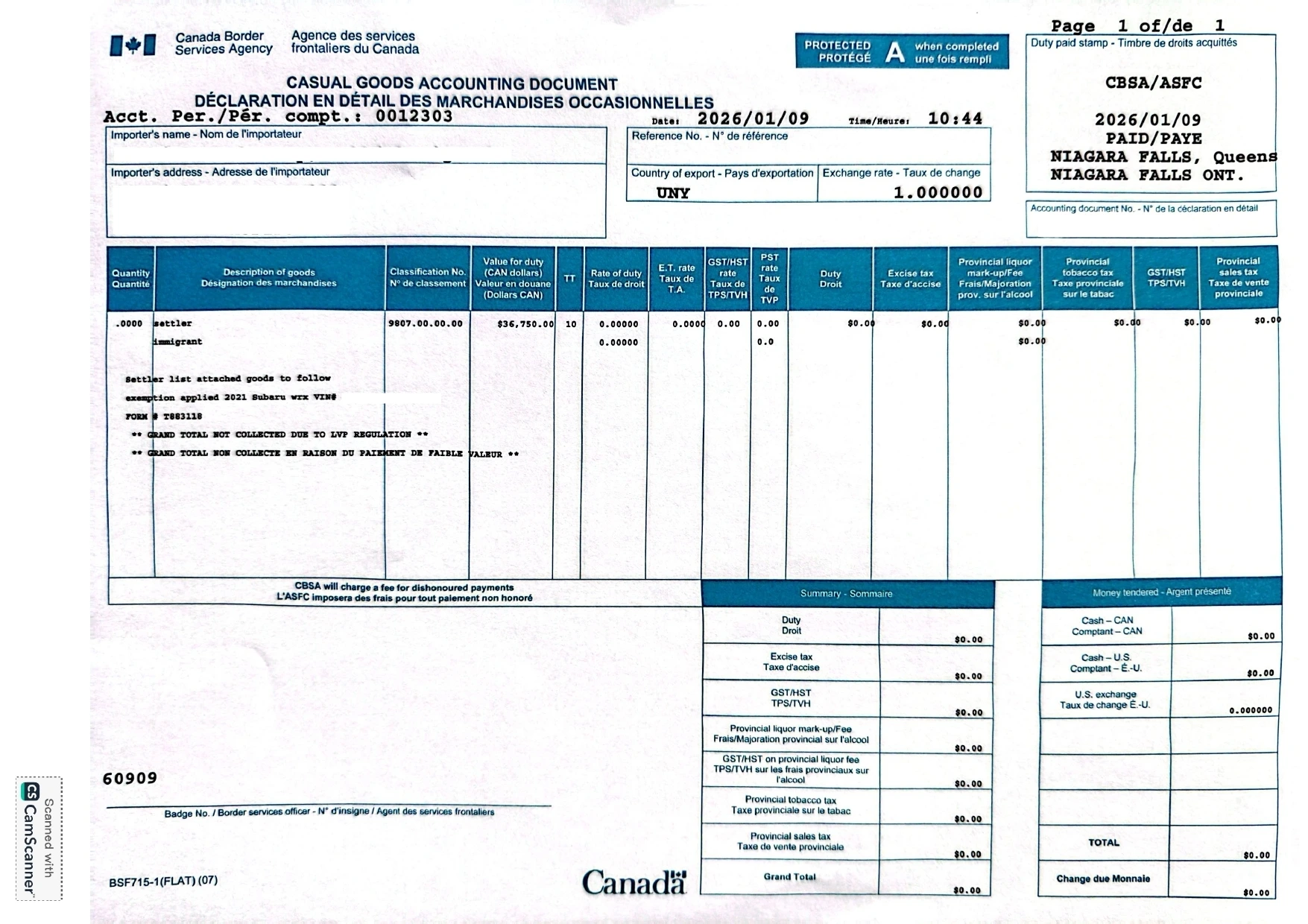
Here is what the $0.00 receipt actually means:
- CBSA has reviewed your declaration, confirmed your eligibility as a settler or qualifying resident, verified that your goods are used personal effects as declared, and determined that no duties or taxes are owed on the importation. The receipt is the official government confirmation that your goods entered Canada legally, were assessed by a customs officer, and were cleared without any financial obligation.
- Keep this receipt. It is your permanent record that the importation was processed correctly and that CBSA has no outstanding claim against your shipment. In the rare event that a question arises later – from Canada Revenue Agency, from a customs broker, or in connection with a future move – this document proves that your household goods were properly imported.
Your moving company should receive a copy of this receipt from the truck driver after the border crossing is complete, and a copy should be passed on to you as part of your move documentation. If you do not receive it, ask for it specifically. It is an important document to have on file.
The $0.00 outcome is the result of preparing your documentation correctly from the beginning – completing the right forms, presenting them to a CBSA officer before your shipment arrives, listing your belongings accurately, and ensuring your immigration status is in order. When all of those pieces are in place, the border crossing is a confirmation of what you already declared, not a negotiation.
Tips to Avoid Customs Problems When Moving to Canada
Even with the right forms and a well-organized shipment, there are specific situations that can complicate customs clearance at the Canadian border. Knowing about them in advance gives you the opportunity to address them before moving day – not at the port of entry.
Items That Cannot Be Imported or Require Declaration
Canada has clear rules about what can and cannot enter the country, and some of these rules catch people off guard when moving from the USA. The following categories require special attention:
- Firearms and weapons. Firearms can be imported into Canada, but the process is strictly regulated. You must declare all firearms at the border, regardless of type. Restricted and prohibited firearms under Canadian law – which includes many handguns and certain semi-automatic rifles – face significant import restrictions that may prevent them from entering the country at all. If you own firearms and plan to bring them to Canada, consult with a Canadian firearms import specialist well before your move. This is not something to leave until moving day.
- Certain food products. Fresh fruits, vegetables, dairy, and meat products are subject to import restrictions that vary depending on the country of origin and the specific product. For a household move from the USA, most commercially packaged and sealed food products are acceptable, but fresh or unpackaged food items may be seized at the border. The safest approach is to consume or discard perishables before the move and not include food products in your household shipment.
- Plants and soil. Live plants, cut flowers, and any items containing soil are subject to inspection by the Canadian Food Inspection Agency (CFIA) as well as CBSA. Some plants may be permitted with proper documentation; others will be seized. Houseplants are a common oversight – if they are in your shipment, declare them on your forms and be prepared for them to be inspected or denied entry.
- Prescription medication. You may bring your personal prescription medication into Canada, but quantities should be consistent with personal use – typically no more than a 90-day supply. Bring the original pharmacy-labeled containers and, if possible, a copy of the prescription. Large quantities of medication or unlabeled containers will attract scrutiny.
- Cannabis products. Despite cannabis being legal in both Canada and certain US states, transporting cannabis across the international border in either direction remains a federal offense under both Canadian and US law. Do not include any cannabis products in your moving shipment.
- Alcohol and tobacco. These are dutiable goods. You may bring limited personal quantities across the border duty-free, but quantities beyond personal allowances will be assessed duties and taxes. If your shipment includes a large wine collection, a home bar, or a bulk supply of tobacco products, declare them accurately and be prepared for duties to apply.
- Vehicles. If you are importing a personal vehicle as part of your move, this is handled as a separate process from your household goods declaration and requires its own documentation through Transport Canada and the Registrar of Imported Vehicles (RIV). Do not include a vehicle in your household goods declaration.
Situations When Duties or Taxes May Apply
The duty-free importation of household goods is a privilege extended to people who qualify as settlers or returning residents under CBSA's rules. In certain situations, that exemption does not apply – and duties or taxes will be assessed.
- New or unused items. Goods that were purchased new and have never been used are not considered personal effects in the same way that your existing belongings are. If you bought new furniture, appliances, or electronics specifically in preparation for your move and they have never been used, CBSA may assess duties and taxes on those items. The threshold for what counts as "used" is not always black and white, but items still in original packaging with no signs of use are a clear risk.
- Items acquired after establishing residence in Canada. If you entered Canada and then purchased items in the USA that you are now importing, those goods are not part of your original settler's effects declaration. They may be subject to duties depending on their category and value.
- Items not listed on your BSF186A. Goods found in your shipment that do not appear on your declared inventory are treated as undeclared imports. Depending on the item, CBSA may assess duties and taxes or, in serious cases, seize the goods entirely. This is why an accurate and complete inventory matters so much.
- Commercial goods. If your shipment includes items intended for resale, business inventory, or commercial use rather than personal household use, those goods are not covered under the settler's exemption. They require separate commercial customs documentation and will be assessed duties and taxes accordingly.
- Gifts. New items that are clearly gift-packaged and intended for others – rather than for your personal household use – may be treated as dutiable goods. Modest gifts brought in personal luggage are generally acceptable, but a moving truck loaded with gift-wrapped items alongside your household goods is a different situation.
- Exceeding the allowance period. For Goods to Follow, there is a time limit on how long after your entry into Canada you can import your goods under the settler's exemption. Goods must generally arrive within a reasonable period following your establishment of residence. Shipments that arrive significantly later may face additional scrutiny regarding their eligibility for duty-free status. Confirm the current allowance period with your moving company or a customs broker before your move.
Quick Customs Clearance Checklist for Movers
Use this checklist to confirm that your customs documentation is complete and in order before your moving truck departs the United States:
Forms and documents:
- Form BSF186 completed in full, signed, and dated
- Form BSF186A completed with detailed inventory, values in Canadian dollars, signed and dated
- Both forms stamped by a CBSA officer at a port of entry or Canadian airport
- Valid passport accessible and not packed in the moving truck
- Immigration documents (PR visa, work permit, study permit, or citizenship documentation) in hand
Inventory accuracy:
- All large items listed individually with descriptions and estimated used values
- All packed boxes described by contents – no "miscellaneous" entries without further detail
- High-value items (jewelry, art, electronics, instruments) listed individually
- Any restricted items (firearms, medication, plants) declared and handled separately
- No items in the truck that are not on the inventory
Logistics coordination:
- Moving company has confirmed which port of entry the truck will use
- Timing of your border appearance coordinated with the truck's scheduled crossing
- Stamped copies of your forms provided to the truck driver before departure
- Personal copies of all forms kept with you – not in the moving truck
- Moving company has confirmed receipt of stamped forms before the truck departs
After the border crossing:
- CBSA $0.00 tax receipt received and filed with your move documents
- Confirmation from moving company that shipment cleared the border without issues
- Delivery date and final destination confirmed
A cross-border move from the USA to Canada is a significant life event, and the customs process is one of the most important logistical steps in making it go smoothly. The paperwork is not complicated once you understand what is required and why each document exists. Prepare your forms carefully, appear before a CBSA officer at the right time, and work with a moving company that knows the Canada-USA customs process from experience.
When everything is in order, your household goods cross the border, a $0.00 receipt is issued, and your belongings are delivered to your new home in Canada – exactly as planned.
Popular USA–Canada Moving Routes
Explore our destination-specific moving guides for planning, customs information, FAQs, and real cross-border moving cases.
Planning a Move from the United States to Canada?
Get a personalized cross-border moving quote and a clear checklist of the CBSA documents required for your shipment.